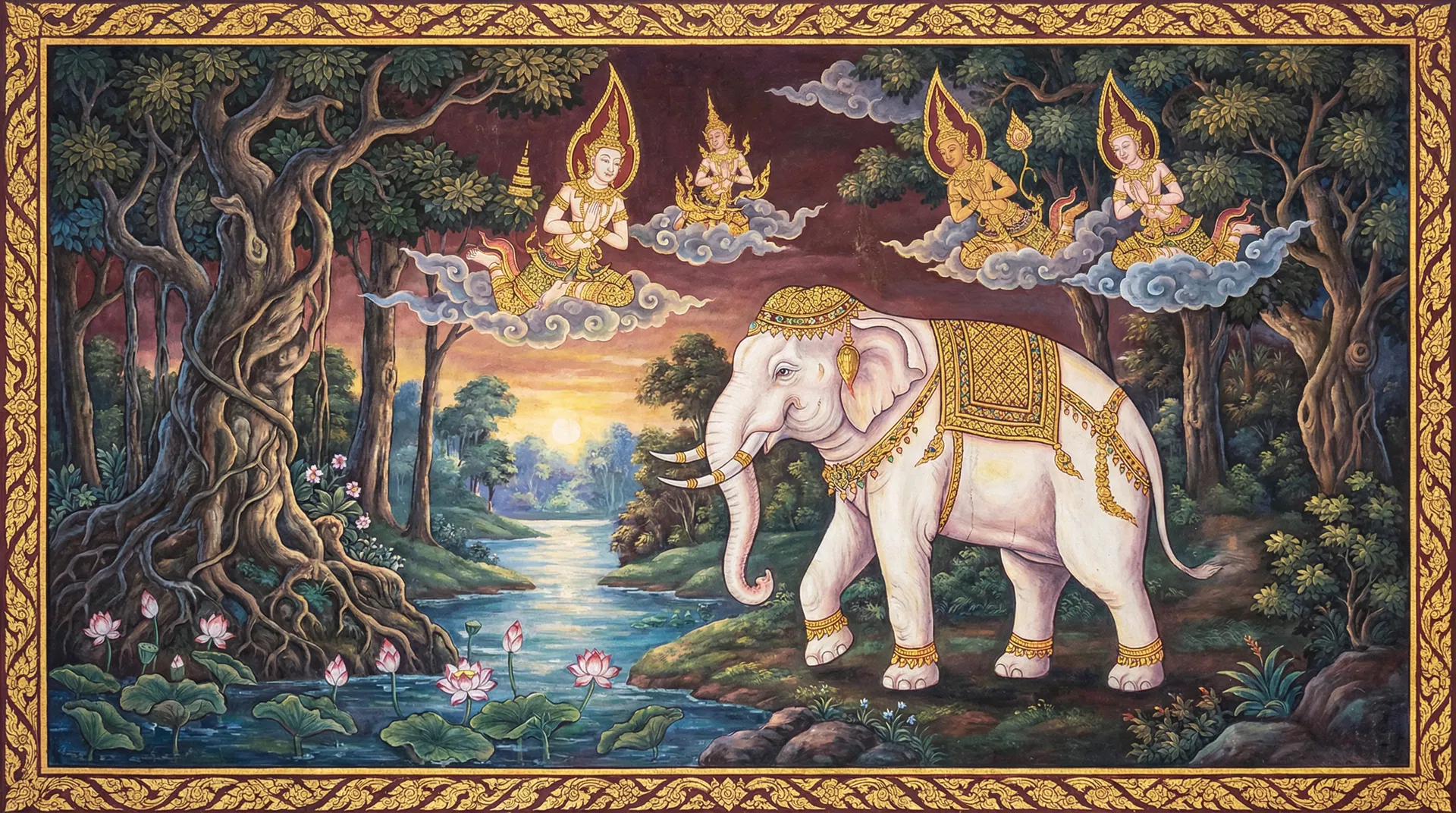
Mahamora Jataka
Mahamora Jataka
In a lush and verdant forest, teeming with life and vibrant with the songs of countless birds, there stood a magnificent banyan tree. This was no ordinary tree; it was ancient, its branches stretching towards the heavens like gnarled arms, and its roots delving deep into the earth. Within the hollow of its mighty trunk resided a magnificent peacock, not just any peacock, but a Bodhisattva in a previous life, known for his unparalleled beauty and his exquisite singing voice. His name was Mahamora, and his plumage shimmered with all the colors of the rainbow, catching the sunlight and scattering it into a thousand dazzling hues. His voice, when he sang, was said to be so melodious and pure that it could charm even the most savage beasts and bring peace to the most troubled heart.
Mahamora lived a secluded life, content with his solitude, his days filled with singing and meditating. He understood the impermanence of all things and found joy in the simple harmony of nature. However, his extraordinary talent did not remain hidden for long. A hunter, known for his cruelty and insatiable greed, roamed the forest, always seeking rare and valuable prey. His name was Kala, and his heart was as dark as the shadows he lurked in.
One day, Kala, hidden behind a thicket of bushes, heard the enchanting melody of Mahamora's song. He had never heard anything so beautiful. His eyes gleamed with avarice. "This magnificent creature must be mine!" he thought. "Its feathers will fetch a king's ransom, and its voice will be a treasure for my ears alone." He resolved to capture the peacock, no matter the cost.
Kala spent days observing Mahamora, learning his habits, and devising traps. He knew that a direct confrontation would be futile; the peacock was too swift and too aware. He decided to use cunning and deceit. He fashioned a net of fine, strong sinews, almost invisible in the dappled sunlight, and a snare that could be triggered from a distance.
On a particularly bright morning, Mahamora, feeling at peace, began to sing his most beautiful song. Kala, lying in wait, saw his opportunity. He stealthily moved into position and, with a flick of his wrist, cast the net over the unsuspecting peacock. Mahamora, startled, struggled, but the net was strong. He was caught!
As Kala emerged from his hiding place, his face contorted with a triumphant, cruel smile, Mahamora, despite his predicament, did not despair. He knew that his physical form was trapped, but his spirit remained free. He looked at the hunter with calm eyes and spoke, his voice, though strained by the net, still held a semblance of its former beauty. "Hunter, why do you seek to harm me? I have caused you no offense. I live in peace, singing my songs to the forest. What is it you truly desire?"
Kala, taken aback by the peacock's calm demeanor and articulate speech, scoffed. "Foolish bird! I desire your magnificent feathers and your enchanting voice. They will bring me wealth and admiration."
Mahamora, understanding the hunter's greed, decided to teach him a valuable lesson. He said, "O hunter, your desire for wealth is understandable, but it blinds you to true worth. If you release me, I will sing for you a song that will fill your heart with such joy and contentment that you will never again feel the need for material possessions. I will sing a song that will reveal the true treasures of life, treasures that cannot be bought or sold."
Kala, intrigued and a little bewildered, hesitated. The idea of a song that could bring such profound joy was tempting, especially to someone who felt a constant emptiness within. He was also somewhat intimidated by the peacock's wisdom. "Very well, bird," he said, reluctantly loosening the net slightly. "Sing your song. But if you fail to impress me, or if you try to escape, I will surely kill you."
Mahamora, now with a little more freedom to move, took a deep breath and began to sing. It was not just a song of beautiful notes; it was a symphony of wisdom. He sang of the impermanence of life, of the fleeting nature of beauty and wealth. He sang of the joy found in simple things, in the warmth of the sun, the rustling of leaves, the gentle flow of a stream. He sang of the peace that comes from a contented mind, free from greed and desire. He sang of the interconnectedness of all living beings and the importance of compassion.
As Mahamora sang, a transformation began to occur within Kala. The greed that had clouded his heart started to dissipate. The emptiness he felt began to fill with a strange, new sense of peace. He found himself captivated not just by the melody, but by the profound meaning woven into the lyrics. He saw his own life, driven by a relentless pursuit of wealth, as a sad and pointless endeavor.
When Mahamora finished his song, the forest was silent, save for the gentle whisper of the wind. Kala stood frozen, tears streaming down his face. He looked at the peacock with awe and gratitude. He dropped his hunting tools, his desire for wealth completely extinguished. "O noble bird," he stammered, his voice choked with emotion. "You have shown me the true meaning of life. I was a fool, blinded by greed. I have never known such peace and happiness as I feel now. Please, forgive me."
Mahamora, seeing the genuine remorse and transformation in the hunter's heart, smiled. "Your willingness to change is your greatest virtue, hunter. Go forth and live a life of righteousness. Share the joy and peace you have found with others."
Kala, no longer a hunter but a changed man, bowed deeply to Mahamora and walked away, leaving his weapons behind. He never hunted again. Instead, he dedicated his life to helping others, sharing the wisdom he had learned from the Bodhisattva peacock. He found true wealth not in gold or feathers, but in the richness of a virtuous life and the contentment of a peaceful heart.
Mahamora, the Bodhisattva peacock, continued to live in his banyan tree, his songs now carrying an even deeper resonance, a testament to the power of wisdom and compassion to transform even the darkest of hearts. The forest, and all its inhabitants, were blessed by his presence and his teachings.
— In-Article Ad —
💡Moral of the Story
True wealth and lasting happiness are not found in material possessions or the satisfaction of greed, but in wisdom, contentment, compassion, and a life lived virtuously. Wisdom and compassion have the power to transform even the most hardened hearts.
Perfection: Wisdom (Panna)
— Ad Space (728x90) —
More Jataka Tales You May Enjoy
 215Dukanipāta
Cullabodhi Jataka
The Courage of ConvictionIn the vibrant city of Savatthi, lived a prince named Bodhi. He was not the...
💡 True courage lies in upholding justice and compassion, even in the face of opposition. Lasting order and prosperity are built on mercy and understanding, not on fear and harshness.
315CatukkanipātaTemiya Jataka
Temiya JatakaIn the grand city of Varanasi, nestled beside the sacred Ganges, ruled a wise and just ...
💡 True liberation comes from understanding the impermanence of worldly life and the suffering it entails, leading to detachment and the pursuit of spiritual freedom.
 41Ekanipāta
The Tale of the Clever Crow
The Tale of the Clever Crow In the ancient city of Varanasi, nestled beside the sacred River Ganges...
💡 Disobedience to the teachings of experienced and benevolent individuals leads to suffering and destruction. Leaders must possess patience, sacrifice, and guide people towards the right path.
14EkanipātaThe Bodhisatta as a Hunter
The Bodhisatta as a HunterIn the dense, untamed wilderness of the Himalayas, where snow-capped peaks...
💡 True compassion transcends self-preservation, and great sacrifices bring immeasurable blessings.
74EkanipātaThe Tale of the Sword
In the prosperous Kosala kingdom, within the renowned city of Savatthi, where King Pasenadi, the rig...
💡 True strength lies in collective effort, resourcefulness, and perseverance, not in mythical solutions.
91EkanipātaNimi Jataka
Nimi JatakaIn the celestial realm, where clouds of pure gold drifted lazily across an endless sapphi...
💡 The pursuit of wisdom and righteousness leads to profound understanding and brings peace and prosperity not only to oneself but to all of society. Witnessing the consequences of karma provides powerful motivation for virtuous living.
— Multiplex Ad —